

Cruising 70mph down the interstate. In pre-dawn darkness. On wet roads.
Suddenly, from out of nowhere, a speeding vehicle comes down an on-ramp and crosses the solid white line, triggering slamming breaks, sideswiping vehicles . . . and spilled coffee everywhere. Only expert handing behind the wheel—and the merciful hand of God—prevented an otherwise inevitable barrel-role.
The offending vehicle vanishes off into the darkness. The only other vehicle involved in the accident, a pickup truck in the passing lane, pulls off the side of the road to help access the damage.
I stood next to the dented door and and scraped paint of my friend’s blue sedan last Sunday as he recounted the nerve-racking story from his travels over the Labor Day weekend. How grateful I was that he was alive and we could be chatting there like normal!
But his story reminded me of an unexpected connection to the world of photography. While it doesn’t have anything to do with the artistic side of photography, have you ever thought about which photography techniques would help capture clear evidence after a car accident?
Most car accident claims are decided by details nobody thinks to document: a skid mark that fades by morning, a phone left glowing on a dashboard, glass scattered in a pattern no repair shop photo could ever recreate.
Roughly 6.18 million police-reported crashes happen in the U.S. every year, and in the vast majority of them, the case gets built on whatever a phone camera captured in the first few minutes after it happened. Adjusters and courts don’t work from memory. They work from documentation, and the driver who takes the right photos can influence the story long before anyone else has a say.
Why the First Photos Matter More Than People Think
Insurance adjusters and opposing attorneys work from documents, not memories. A photo taken minutes after impact shows conditions no one can convincingly recreate later: fresh fluid leaks, glass scatter, the exact resting position of each vehicle. Once tow trucks arrive and vehicles get moved, that scene disappears permanently.
Speed matters, but so does order. A driver who photographs bumper damage first and the wide scene second loses the context that shows how the crash actually happened. Wide shots first, close-ups second, is the rule to remember when under stress.
Capture the Wide Scene Before Anything Moves
Before touching a damaged vehicle or picking up debris, a driver should back up and shoot the full scene from several angles. That means standing at each corner of the intersection or roadway and capturing both vehicles, the road markings, and any traffic signals in a single frame where possible.
As Brent Stewart, a Rock Hill car accident lawyer and founding attorney of Stewart Law Office (recognized in The Best Lawyers in America®, holding over 1,300 5-star Google client reviews through various platforms and featured in Attorney at Law and Super Lawyers) points out, “Document everything from the scene. Take photos of every vehicle involved, from every angle. Get the damage photos, license plates, insurance information, and road conditions. If there are skid marks, photograph them. Get names and phone numbers of all witnesses. These people move, forget, and become unreachable. If you have their information right from the scene, your attorney can follow up later.”
These wide shots establish the physical layout: lane position, distance from the intersection, and the direction each vehicle traveled. A single close-up of a dented fender cannot recreate any of that. Four or five wide angles, taken from different points around the scene, usually cover it.
Get Close on Vehicle Damage and Contact Points
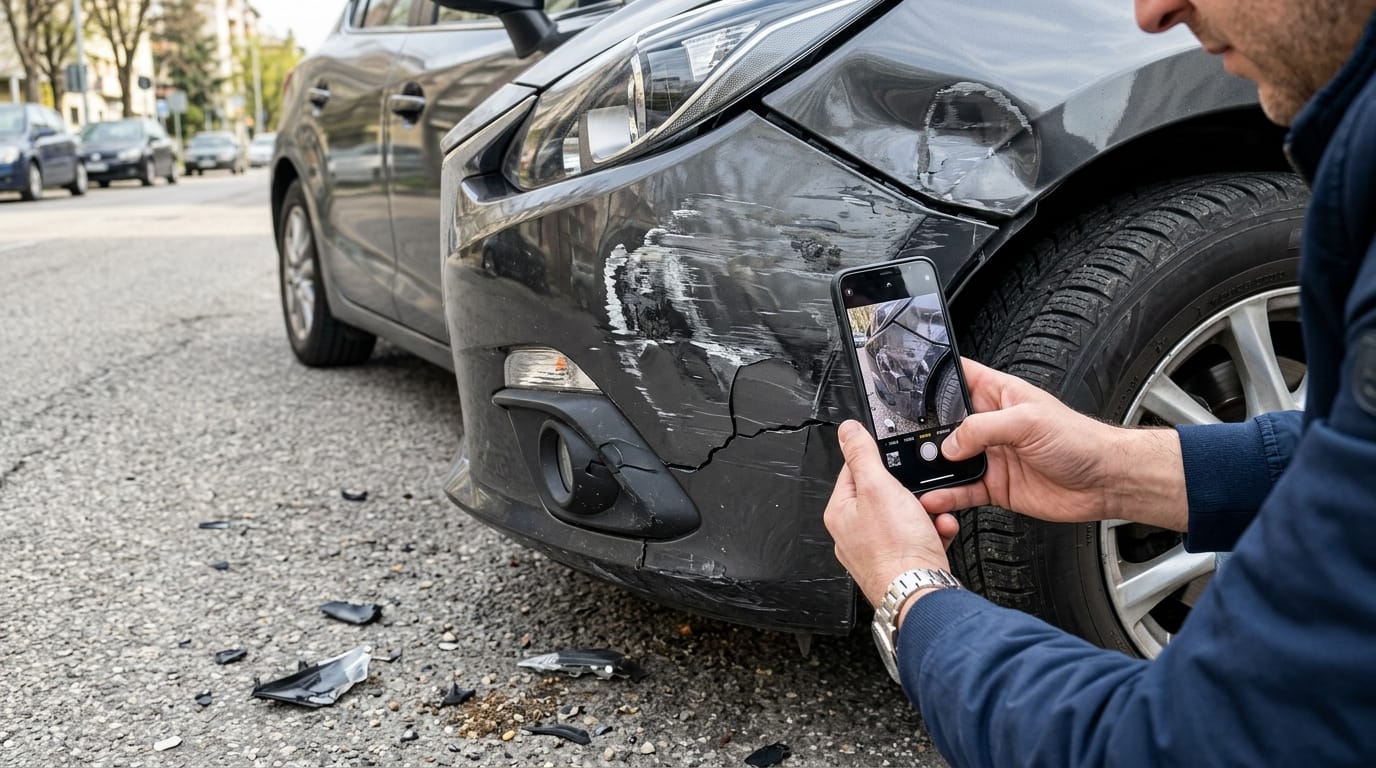
Once the wide shots exist, move in on the damage itself. Photograph every point of contact from multiple distances: one shot showing the damage in context with the rest of the vehicle, one closer shot isolating the dent or scrape, and one extreme close-up if paint transfer or debris sits in the damage.
Damage height and shape often reveal impact speed and angle, the type of details a repair estimate alone won’t show. A bumper crushed low and to one side tells a different story than one crushed straight across. These are the kind of differences an adjuster reviewing photos months later would have no other way to see.
Photograph License Plates, VINs, and Insurance Cards
Small details get lost quickly. A clear photo of the other driver’s license plate, insurance card, and driver’s license removes any dispute later about who was actually involved. The vehicle identification number, usually visible through the windshield on the driver’s side dashboard, ties a specific vehicle to a specific insurance policy without relying on handwritten notes that might contain a typo.
These document photos take thirty seconds and prevent weeks of back-and-forth communication confirming basic facts that should never have been in question.
Document Road Conditions, Skid Marks, and Traffic Signals
Skid marks fade within days, sometimes hours, especially in wet weather. Photographing them immediately, along with the state or condition of traffic signals, any posted speed limit signs, and visible road hazards like potholes or debris, can preserves conditions that directly affect fault determination.
Distracted driving injures roughly 18 people every thirty minutes nationwide, and a phone left visible in a driver’s hand or mounted on a dashboard, caught in a wide photo of the interior, can matter far more than either driver realizes at the time.
Photograph Visible Injuries Without Making a Scene
A photo of a visible injury, taken before medical treatment, documents severity in a way a doctor’s note days later cannot fully capture. This isn’t about lingering on pain. A few clear photos of bruising or swelling, taken with consent from anyone involved, round out the record without turning the scene into a photo shoot.
Use Time Stamps and the Right Camera Settings
Most phone cameras embed a timestamp and, if location services stay on, GPS coordinates directly into each photo file. That metadata quietly confirms when and where each photo was taken, without a driver needing to write anything down.
Photos also hold up better when they are higher quality: shoot in daylight or with a flash rather than relying on streetlights, hold the phone steady rather than shooting while walking, and avoid heavy digital zoom, which blurs fine details like plate numbers.

Why the Effort Pays Off Later
Once a claim moves toward a legal dispute, preserving evidence stops being optional. Federal court rules recognize a duty to preserve information relevant to anticipated litigation, and photos deleted or lost after a crash can create real problems for the person who lost them, even when the loss was accidental. Keeping original photo files, backed up in more than one place, protects against exactly that outcome.
Some states also require formal accident reports beyond what police file at the scene. California, for example, requires drivers to report a crash to the DMV within 10 days when injuries occur, or property damage exceeds $1,000. Photos taken at the scene make that report, and any later claim built on it, far more accurate.
A Simple Order to Follow at the Scene
Even though the focus of Lenspiration’s training material is centered around artistic photography, I hope the information in this article has been helpful in underscoring that documentary photography, whether it’s with a phone, mirrorless, or DSLR camera, is indeed sometimes needful.
So, what photography techniques can help you capture clear evidence after a car accident? In summary, when it’s safe and appropriate, start with wide shots first, then damage close-ups, then documents, then road conditions, then any injuries. That order takes only a few minutes and turns a stressful scene into a clear, usable record!





0 Comments