
After an enlightening workshop in Pennsylvania and a busy HEAV Convention Photography Team, we were headed back to familiar territory. Our spring travels had taken us away from home for 5 weeks! But before crossing the finish line we wanted to make one last stop: a visit with friends in eastern West Virginia. Though we share the same state, they are still many hours away so it’s always a treat when we’re able to connect in person.
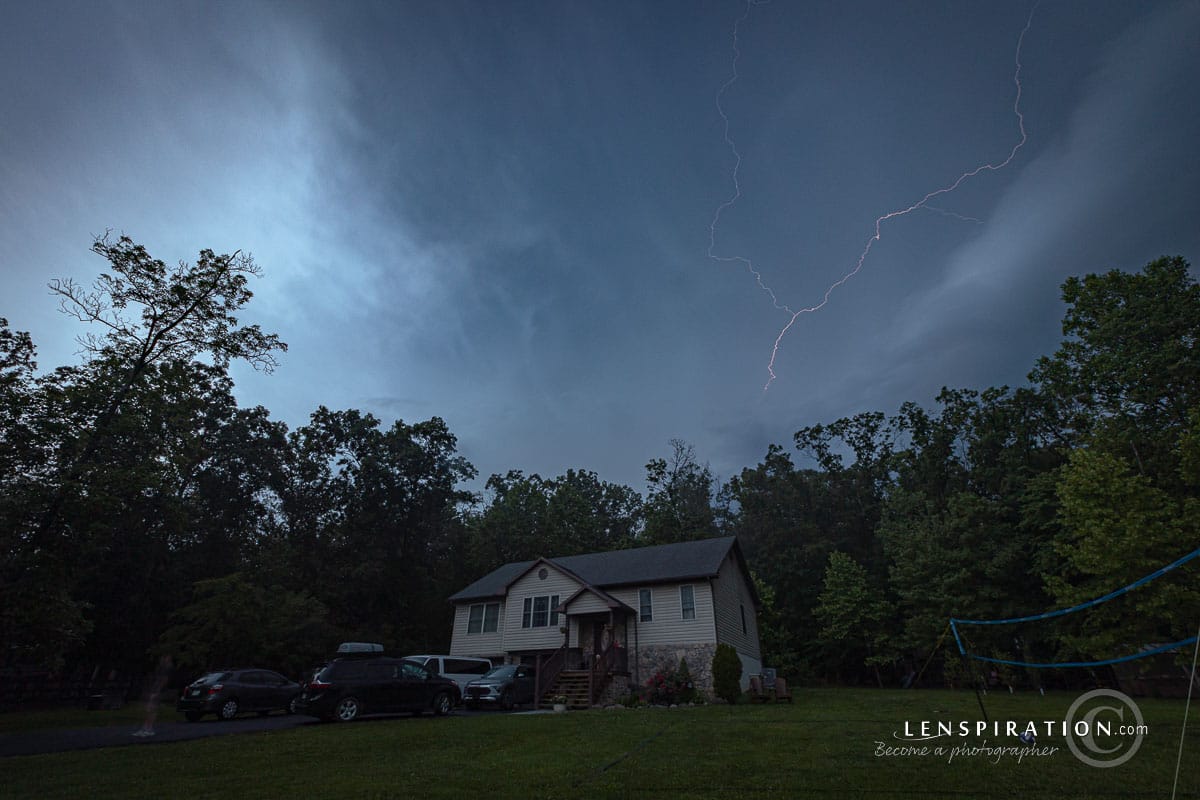
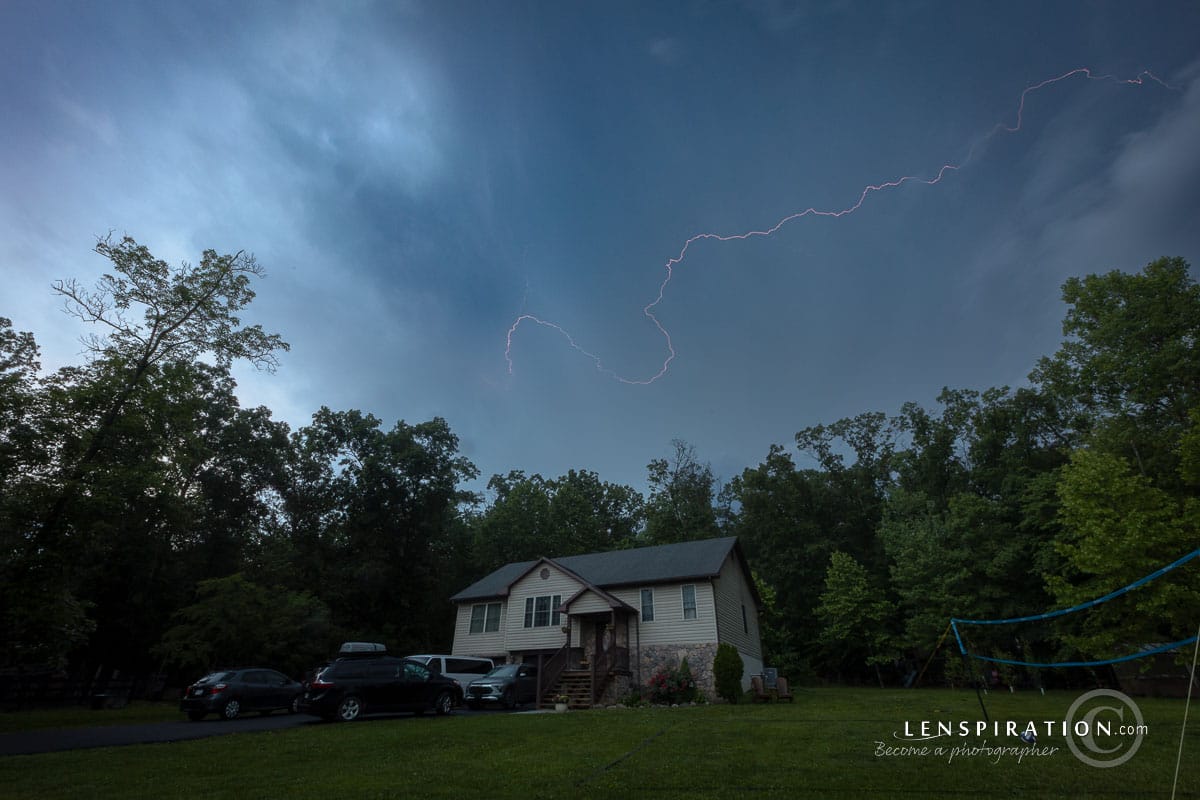
Not too long after we arrived, a thunderstorm arrived as well! We were outside playing Knock Out when dark clouds began to roll in. Thunder could be heard in the distance, the wind picked up, and daylight started to fade. A lightning bolt was seen above the treetops. But interestingly, there was no rain.
“This would be a great time to photograph lightning!” I though.
A Rare Opportunity
I don’t often get the chance to photograph lightning. The mountains where I live in West Virginia obscure long-distance views, and storms usually come with rain, making it hard to shoot. We’re certainly not in Kansas, where you can watch entire storm systems unfold across the plains. But here, with no rain and visible lightning bolts, I had a good opportunity.
I grabbed my tripod and camera and began scouting for a composition. Even with a subject as dramatic as lightning, composition is still king. Of course, I didn’t want to stray far from the house, and I couldn’t control the direction of the storm, so I decided to incorporate the house into the scene. Who knows, the combination of house and lightning in the same frame could make an interesting illustration one day.
The Technical Puzzle
Next, I turned my attention to the camera settings.
It wasn’t night, so it wasn’t super dark. But to increase my chances of capturing a bolt in a photo, I needed to use a slow shutter speed. I set my ISO to 50 and closed the aperture down to f/22. I forget the exact number, but I think the camera suggested a shutter speed of something around 0.5 seconds.
But that posed a problem. If, lets say, a large lightning bolt flashed across the sky every two minutes, I’d be taking nearly 120 continuous shots just to catch one bolt!
I needed to cut light some other way. And that’s when I remembered I had a 3-stop ND filter in the car!
I ran to grab it . . . only to realize it was too small. The thread size was 77mm, and my lens was 82mm. Desperate, I simply held the filter in front of the lens. To my surprise, in a test shot, I saw neither my fingers nor the edge of the filter in the frame! I could now shoot at 2.5 seconds—much better. Over a two minute period, I would only need to take about 23 photos to capture one lightning bolt on average.
But then I thought to myself, “This is going to get super tiring super quick holding the filter like this.” So I set the filter down inside the lens hood and took another test shot. Sure enough, the edges of the filter were still not visible. Praise the Lord! I could now turn my attention on photographing the storm. And thankfully, it was still not raining!
As the storm moved across the sky and more daylight faded, I pushed the shutter speed to 5 seconds. In total, I ended up taking about 67 photos. And out of those, only two had lightning in them. But at least I had captured something!
Why Such Thin Lightning Bolts?
Reviewing the shots, I noticed something odd: the lightning bolts were surprisingly thin. Most lightning photos you see taken by professional photographers feature thick, dramatic strikes. These were barely visible on my camera screen! Why?
Was it just because the lightning bolts themselves were naturally thin? Or was it something else?
Could it be the time of day? Unlikely—I’ve seen plenty of lightning photos that were not taken at night.
Perhaps it was aperture! I knew from experience when photographing fireworks that using a smaller aperture will make the trails of fire thinner in the photo. I had used f/22 and f/16 for my lightning photos here. Was the narrow aperture making the lightning bolts thin? Would using a wider aperture making them thicker?!
I wasn’t able to test my theory that day. The storm had passed. But a couple months later, during our summer travels, I got another chance!
A Second Opportunity
Texas, with its flat terrain, is a great place to photograph storms. At the end of the Big Sandy Family Conference, we had just finished up the Photography Team and were headed off to the coffee shop to celebrate a long week of event photography. And that’s when one of the students noticed some storm clouds on the horizon. Lightning was flashing magnificently in the center of the clouds, so we grabbed our gear and set up right there next to the parking lot!
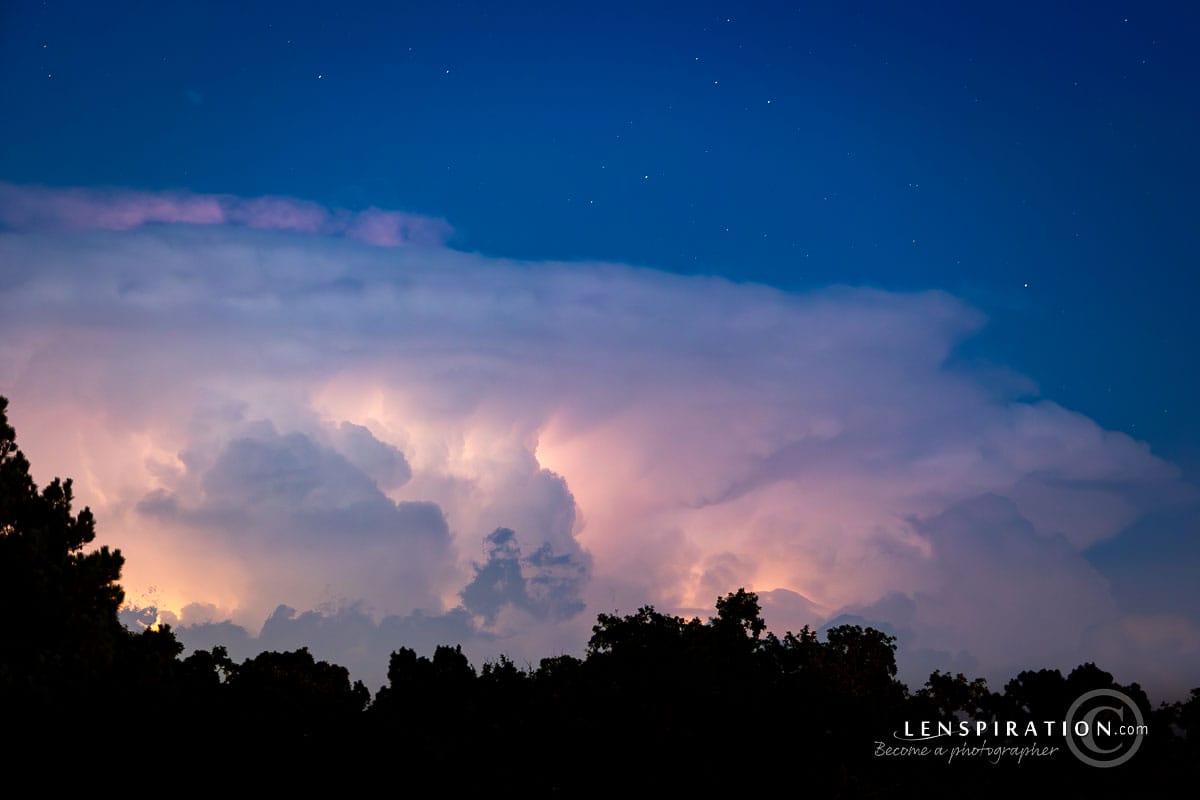
Illuminated
Big Sandy, Texas
Download as a free desktop background in the next Latest from Lenspiration update (subscribe)
This time, it was dusk—blue hour. The sky was dark but not black, perfect for dramatic photos. And because it was so much darker outside than the other storm experience in West Virginia, I could use a wide aperture this time! I set it to f/2.8. I would soon find out if aperture actually played a role in the thickness of lightning bolts!
Because the storm was off in the distance, I used a telephoto lens. I didn’t want the clouds to look too blurry, so I set the shutter speed to 10 seconds, the longest I was comfortable with. This resulted in the need to use ISO 800 to make the photo a descent exposure. But that was ok. I could deal with that level of grain in post-processing.
At f/2.8, I couldn’t wait to see what would happen! Can you guess what the lightning bolts looked like?
I only managed to capture bolts in two of the 17 photos I was able to get before the storm moved out of sight. In the following shot you can see just a very tiny line in the far left side of the photo.
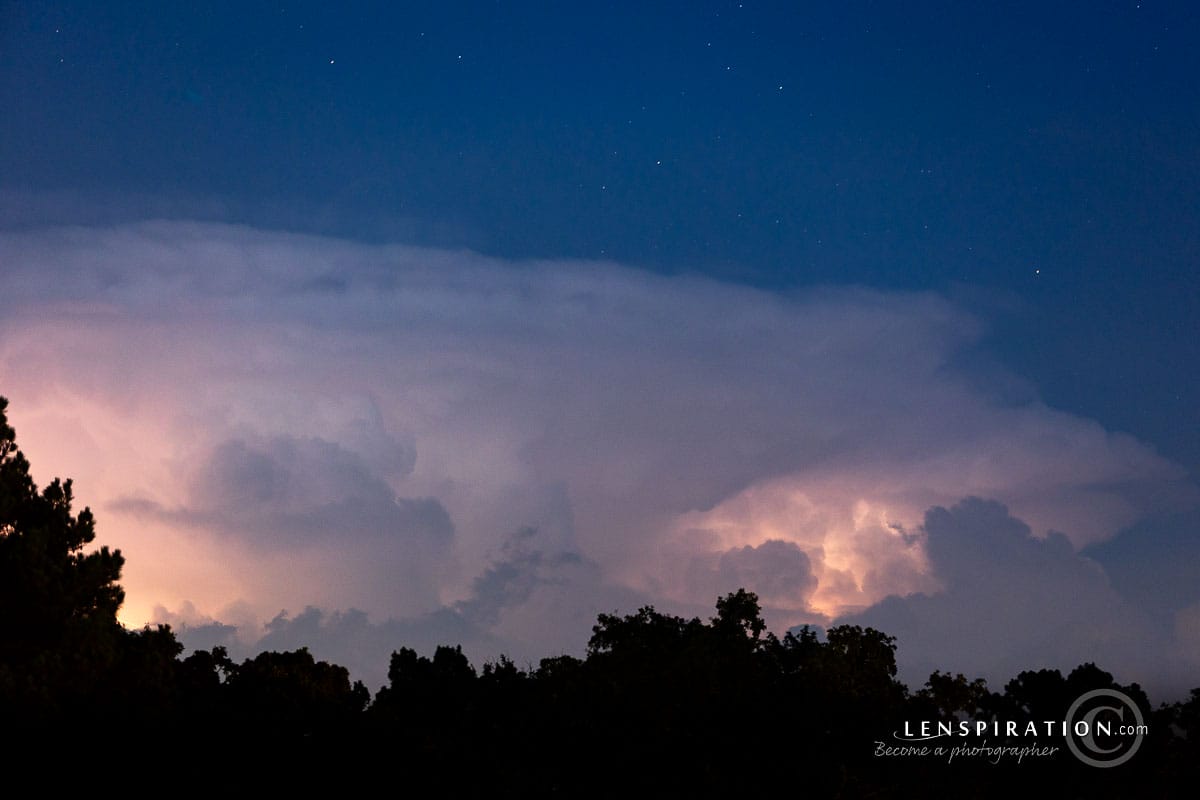
But in the following shot, you can see the lightning a whole lot better!
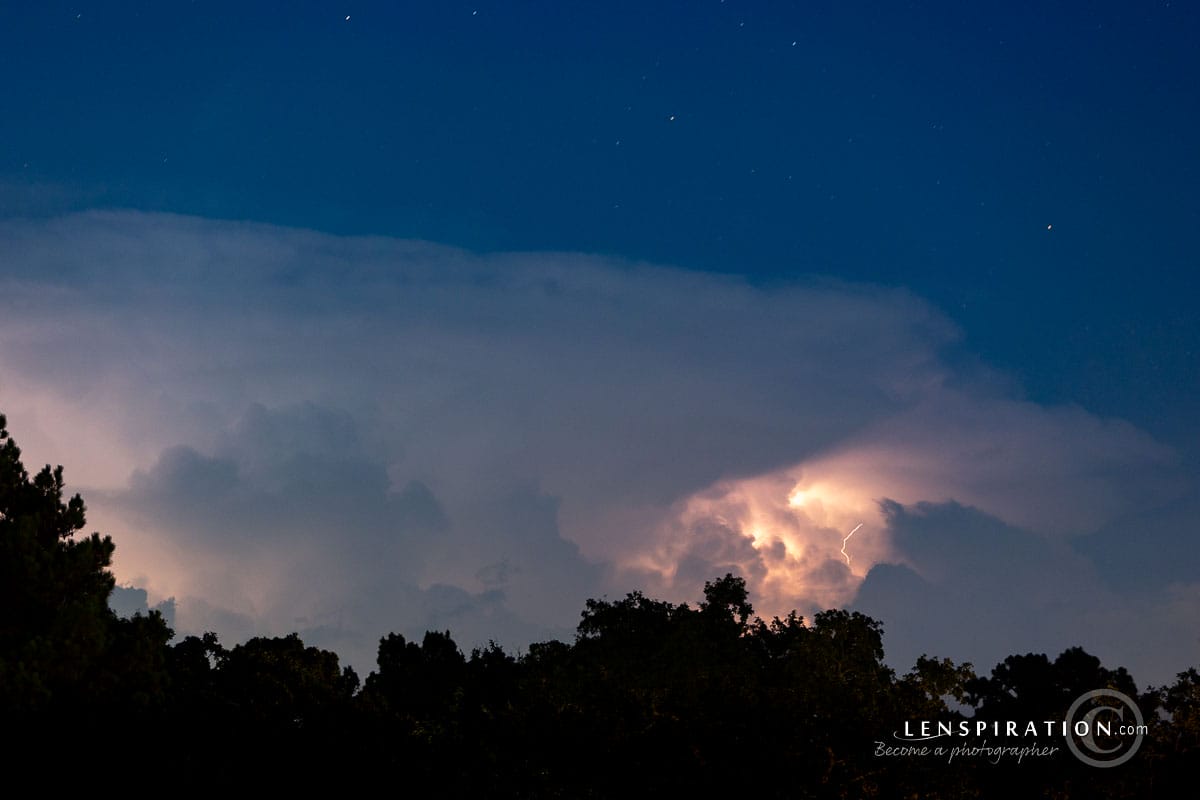
Is the lightning bolt any thicker?
Not really!
I was truly surprised. I learned that day that if aperture plays any role in the thickness of a lightning bolt, it isn’t much.
Perhaps the thinness is due to the storm’s distance? Possibly. I’ll have to do more experimenting to find out for sure.
Final Thoughts
From what I can tell so far, though aperture might influence lightning thickness, it doesn’t have a noticeable effect. I’ll likely keep using narrow apertures when photographing lightning during daylight hours to keep landscape sharp from foreground to sky, plus allow for the longest shutter speeds possible. And at night, I’ll continue to use wide apertures to let more light in and keep ISO as low as possible.
“Whatsoever the LORD pleased, that did he in heaven, and in earth, in the seas, and all deep places. He causeth the vapours to ascend from the ends of the earth; he maketh lightnings for the rain; he bringeth the wind out of his treasuries” (Psalm 135:6-7).
And thus concluded our electrifying last-stop at the end of our spring travels. In future blog posts, I can’t wait to share with you more photos and stories from our summer travels, exploring everything from a mansion and canyons to red rock monoliths and the sobering reality of a live wildfire.




0 Comments
Trackbacks/Pingbacks